One day while walking on the streets, philosopher Friedrich Nietzsche saw a man whipping a horse because it wouldn’t move. The beast was clearly unable to move, and Nietzsche threw himself between the horse and its tormentor — and fainted. When he awoke, he was never the same again.
Most people would applaud his kindness to the horse, but not Nietzsche. In his eyes he had betrayed his own principles by stooping to pity, a common emotion he believed the enlightened man should avoid.
He apparently understood at that moment that he was not the Superman he preached, and though he was temporarily more energetic and healthy than he had been his entire adult life, it was an energy mixed with insanity as he wrote letters to national leaders claiming to be the world’s savior. Soon he degenerated, mindlessly staring and mumbling, and died 11 years later.
Nietzsche was brilliant but often misunderstood because he used brief, pointed comments called aphorisms that were intended to jolt people and make them think. If taken at face value many of these aphorisms seem hard and cruel. Perhaps for this reason Nietzsche was a popular philosopher in Nazi Germany, where he was used to justify the Nazis’ actions.
One advantage of his aphoristic style, however, is that it is easy to read. Compared with the almost-incomprehensible works of some other philosophers, Nietzsche’s writing is direct, and often funny, especially in “Thus Spake Zarathustra” (1885), his most famous work.
Nietzsche’s philosophy is based on two themes: God doesn’t exist and people are driven only by the desire to obtain power.
Despite all the talk about morals, he argued, morals don’t exist and we shouldn’t pretend they do. Morals are just a facade to cover up people’s real motivation: the desire to control other people and prevent other people from controlling them. He called this the “Will to Power” and claimed that all attempts to construct societies without realizing the centrality of this will to power are doomed.
And since God didn’t exist, he argued, Christianity was just a ploy to keep power in the hands of the majority who resented the few who were more suited to rule.
Another of Nietzche’s concepts is that of the “Superman.” People, he argued, stop short of their potential by needing to be comfortable, or by feeling sorry for themselves. This is why he disliked democracy: it gave power to those who hadn’t proven themselves fit to govern. Man, he said, should become Superman by overcoming his fears, comforts and petty concerns.
Though Nietzche has been used as justification by totalitarians, he was also an inspiration to Sigmund Freud and Jean Paul Sartre. Nietzche argued that people’s expressed reasons for their actions are not their real motivation, and that people can make something of themselves by an act of the will. Freud picked up on the idea of real reasons behind stated reasons to develop psychoanalysis, and Sartre picked up on Nietzche’s idea that man becomes something as he acts.
Sunday, September 19, 2010
A group exhibition by Deano Shirriffs, Jimi Bellaney & Lars Preisser @ Modaks Cafe
Tūrangawaewae : A Place to Stand. A group exhibition by Deano Shirriffs, Jimi Bellaney & Lars Preisser @ Modaks Cafe
Opening - Friday 24th September 5.30pm - 9pm (ish)
featuring some Art, Music & Booze
exhibition runs till 24th October
Artworks in the exhibition inspired by the concept of Tūrangawaewae
Tūrangawaewae is one of the most well-known and powerful Māori concepts. Literally tūranga (standing place), waewae (feet), it is often translated as ‘a place to stand’. Tūrangawaewae are places where we feel especially empowered and connected. They are our foundation, our place in the world, our home.
Opening - Friday 24th September 5.30pm - 9pm (ish)
featuring some Art, Music & Booze
exhibition runs till 24th October
Artworks in the exhibition inspired by the concept of Tūrangawaewae
Tūrangawaewae is one of the most well-known and powerful Māori concepts. Literally tūranga (standing place), waewae (feet), it is often translated as ‘a place to stand’. Tūrangawaewae are places where we feel especially empowered and connected. They are our foundation, our place in the world, our home.

Embrace Noir
I go back to the scene where the two men embrace
& grapple a handgun at stomach level between them.
They jerk around the apartment like that
holding on to each other, their cheeks
almost touching. One is shirtless, the other
wears a suit, the one in the suit came in through a window
to steal documents or diamonds, it doesn't matter anymore
which, what's important is he was found
& someone pulled a gun, and now they are holding on,
awkwardly dancing through the room, upending
a table of small framed photographs. A chair
topples, Sinatra's band punches the air with horns, I
lean forward, into the screen, they are eye-to-eye,
as stiff as my brother & me when we attempt
to hug. Soon, the gun fires and the music
quiets, the camera stops tracking and they
relax, shoulders drop, their jaws go slack
& we are all suspended in that perfect moment
when no one knows who took the bullet--
the earth spins below our feet, a blanket of swallows
changes direction suddenly above us, folding
into the rafters of a barn, and the two men
no longer struggle, they simply stand in their wreckage
propped in each other's arms.
Nick Flynn
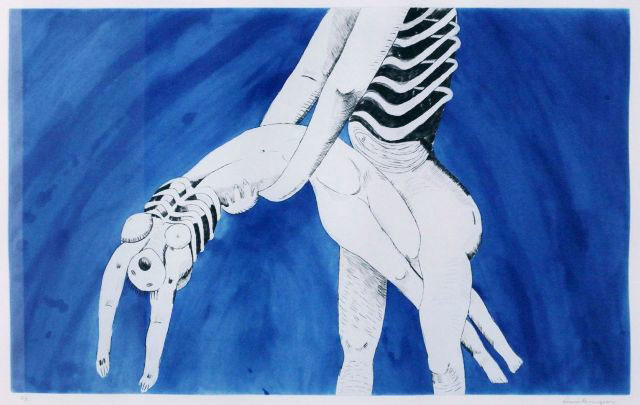
IMAGE: Louise Bourgeois "Triptych for the red room"Etching and watercolor, Collection Xavier Tricot, Ostend.
1/3
A Poison Tree

I was angry with my friend:
I told my wrath, my wrath did end.
I was angry with my foe:
I told it not, my wrath did grow.
And I watered it in fears,
Night and morning with my tears;
And I sunned it with smiles,
And with soft deceitful wiles.
And it grew both day and night,
Till it bore an apple bright.
And my foe beheld it shine.
And he knew that it was mine,
And into my garden stole
When the night had veiled the pole;
In the morning glad I see
My foe outstretched beneath the tree.
William Blake
Photo: Penny Siopis: Three Trees, 2009, ink and glue on canvas, 783⁄4 by 981⁄2 inches; at Michael Stevenson.
Tuesday, September 14, 2010


Monday, August 16, 2010
Sunday, August 15, 2010


Saturday, August 14, 2010
ALBERT ELBAZ
Albert Elbaz is a designer hailed as 'revolutionizing' women's fashion with his simple, yet feminine dresses. He is artistic director of Lanvin, a couture house started by Jeanne Lanvin in the early 1920s. His designs are considered to be a throw back to casual, 'sporty' designs of Jeanne Lanvin. His designs are worn by celebrities such as Kate Moss, Chloé Sevigny & Sofia Coppola.
He is a Moroccan-born Israeli designer. After serving in the Israeli defense forces, he attended the Shenkar College of Engineering and Design in Ramat Gan. He moved to New York city in 1987 and designed for bridal manufacturing designer, before working for Geoffrey Beene. In 1998 he began designing ready-to-wear women's clothing for Yves Saint Laurent. Elbaz was set to take over as head designer of YSL when Saint Laurent retired. This was no to be. The Gucci group limited took over YSL and with Tom Ford as head designer, Elbaz was fired. However he was appointed artistic director of fashion powerhouse Lanvin in Paris October 2001. He has won many awards, such as the international Award (Council of Fashion Designers of America) in June 2005 and was named Chevalier of the Légion d'Honneur, Paris, January 25, 2007. He was also in 2007, Elbaz was listed among Time Magazine's 100 Most Influential People in the World.


He is a Moroccan-born Israeli designer. After serving in the Israeli defense forces, he attended the Shenkar College of Engineering and Design in Ramat Gan. He moved to New York city in 1987 and designed for bridal manufacturing designer, before working for Geoffrey Beene. In 1998 he began designing ready-to-wear women's clothing for Yves Saint Laurent. Elbaz was set to take over as head designer of YSL when Saint Laurent retired. This was no to be. The Gucci group limited took over YSL and with Tom Ford as head designer, Elbaz was fired. However he was appointed artistic director of fashion powerhouse Lanvin in Paris October 2001. He has won many awards, such as the international Award (Council of Fashion Designers of America) in June 2005 and was named Chevalier of the Légion d'Honneur, Paris, January 25, 2007. He was also in 2007, Elbaz was listed among Time Magazine's 100 Most Influential People in the World.


Nan Goldin
“It is very important to me that everybody that I have been close to in my life I make photographs of them. The people are gone, like Cookie, who is very important to me, but there is still a series of pictures showing how complex she was. Because these pictures are not about statistics, about showing people die, but it is all about individual lives. In the case of New York, most creative and freest souls in the city died. New York is not New York anymore. I’ve lost it and I miss it. They were dying because of AIDS.”
- Nan Goldin
IMG: Nan one month after being battered, 1984
IMG 2: Picnic on the Esplanade, 1973
IMG 3: Greer Lankton, 1981
IMG 4: Greer and Robert on the bed, 1982


- Nan Goldin
IMG: Nan one month after being battered, 1984
IMG 2: Picnic on the Esplanade, 1973
IMG 3: Greer Lankton, 1981
IMG 4: Greer and Robert on the bed, 1982


Leonard Cohen, 'Beneath my hands' and 'so long marriane'
Beneath my hands
your small breasts
are the upturned bellies
of breathing fallen sparrows.
Wherever you move
I hear the sounds of closing wings
of falling wings.
I am speechless
because you have fallen beside me
because your eyelashes
are the spines of tiny fragile animals.
I dread the time
when your mouth
begins to call me hunter.
When you call me close
to tell me
your body is not beautiful
I want to summon
the eyes and hidden mouths
of stone and light and water
to testify against you.
I want them
to surrender before you
the trembling rhyme of your face
from their deep caskets.
When you call me close
to tell me
your body is not beautiful
I want my body and my hands
to be pools
for your looking and laughing.
your small breasts
are the upturned bellies
of breathing fallen sparrows.
Wherever you move
I hear the sounds of closing wings
of falling wings.
I am speechless
because you have fallen beside me
because your eyelashes
are the spines of tiny fragile animals.
I dread the time
when your mouth
begins to call me hunter.
When you call me close
to tell me
your body is not beautiful
I want to summon
the eyes and hidden mouths
of stone and light and water
to testify against you.
I want them
to surrender before you
the trembling rhyme of your face
from their deep caskets.
When you call me close
to tell me
your body is not beautiful
I want my body and my hands
to be pools
for your looking and laughing.


Thursday, August 5, 2010

Sunday, August 1, 2010
MARROW MAGAZINE FRIDAY THE 13TH RELEASE GIG

MARROW MAGAZINE PRESENTS:CONNIPTION, THE DOYLEYS, SYNESTHESIA AND OLD PSYCHIATRISTS CLUB [WITH A DJ SET FROM STRANGER DANGER]. IN ASSOCIATION WITH MINT DVD RENTAL, LANYOP GALLERY AND BLACKSTAR BOOKS. AUGUST ISSUE OUT FRIDAY 13TH. AT REFUEL AUGUST 13TH, 2010. DOORS 9PM. STUDENT/UNWAGED $2, WAGED $5. COME PARTY
Thursday, July 29, 2010
Jessica Kitto


Jessica Kitto
Second Year BVA Jewellery, Dunedin School of art.
‘Bones’
This piece consists of French knitted tubes, embedded with hand carved bones. The bones were originally made of stone and carved with a diamond headed drill. They were made to appear delicate and thus representative of the body’s fragility, with the knitted tubes encasing the bones evoking, in contrast, a sense of physical comfort and warmth. Through the use of wool the piece is designed to ‘snuggle’. The knitted tubes also act as a form of protection for the bones, alluding to the anatomical formation of the human body. The selection of colours reflects this idea of anatomy, the deep red is symbolic of the inner workings of the body; both the red and white representing the protective and functional quality of human flesh and blood. ‘Bones’ is a particularly interactive piece due to the fact it can be interpreted as you will and in that it is a three dimensional object that, when worn, acts as an experience evoking a particularly physical response due to its emphasis on the corporeal.
“All these things you’ve given me”
“All these things you’ve given me” consists of every piece of jewellery the artist has ever been given by significant loved ones. Every piece holds a sentimental value to the artist and is specific to a memory or an emotional attachment she has to the particular person from whom she received it. The piece was constructed through linking one piece to another. Each individual piece holds up another, so if one falls down, it won’t be alone. The work can also be likened to a spider web, the web like formation associated similarly, to how we each carry distinctive memories or attachments, which define who we are. The subjective nature of the piece means that it is both unfinished and cannot be worn by other people, due to the emotional attachment and significance the artist has to each individual piece. The more the piece grows the more emotionally heavy and unwearable it becomes to anyone, but the artist.
N.B.
1: Bones
2: All these things you've given me
James Bellaney


These are pieces from my favourite Dunedin-based artist, James Bellaney. Bellaney is a fourth year painting student at the Dunedin school of art. Stylistically, Bellaney’s work is reminiscent of the intimacy felt in Surrealist automatism, American action painting and Abstract Expressionism. This is evident from the quality of his work, which has the appearance of being somewhat considered, yet spontaneously gestural and improvised. Bellaney’s creative process involves methodically moving the paint by means of splashing, staining, stumbling and dripping across the working space. Often it appears as though he is using seemingly random tools, as opposed to the more traditional paint brush.Upon viewing him work, his figure is reminiscent to that of to Hans Namuth’s photographs of American Abstract expressionist, Jackson Pollock. Bellaney, not dissimilar to Pollock and other artists, such as transgressive artist Vito Accohi, Australian artist Dale Frank, Paul McCarthy, Pablo Picasso (particularly the film featuring him paint on glass) and many kinetic sculptors use art to convey ranging emotions and subsequent reflections upon their individual lives. However Bellaney’s pieces have a quintessential spiritual quality, which I believe is apparent because of his Maori heritage. This sense of spirituality I would liken to not only his works kinetic flow of energy (a reference to music and surfing), but also the strongest of his influences comes from his own environment, nature. As a sense of the calming waves and aggressive internal conflict merge together to create a chaotic rhythm of his perceptions of his own environment and sense of identity.
N.B.
1. A Hans Namuth portrait of Jackson Pollock (1950), http://www.npg.si.edu/exh/namuth/pol3nam.htm
2. Bellaney at his performance-based exhibition at none gallery earlier this year
3. Piece from the collection, 'Natural landscapes'
4. Piece from the collection, 'Corrosion'
Subscribe to:
Posts (Atom)